
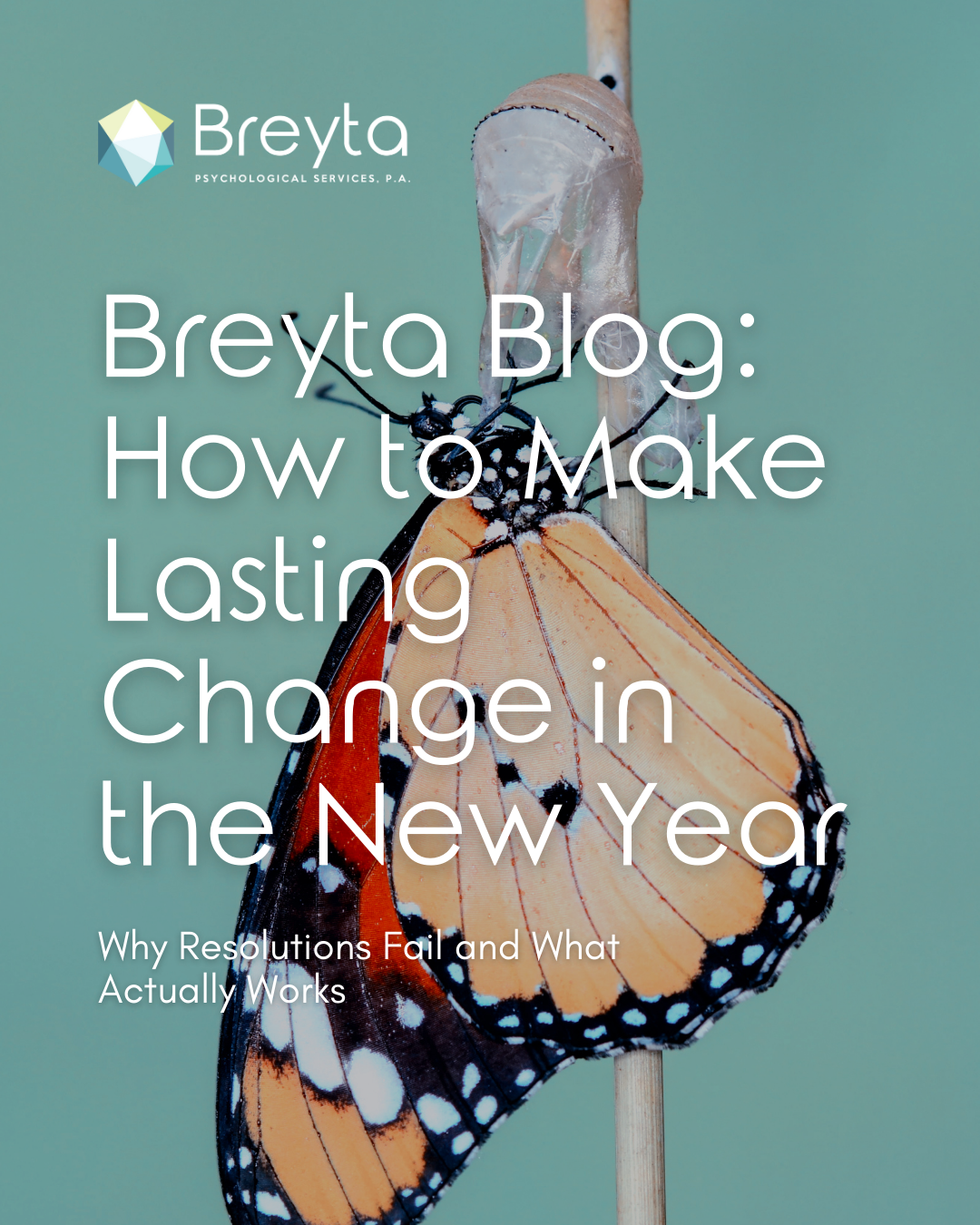
Why Resolutions Fail and What Actually Works
by Vanessa H. Roddenberry, Ph.D.
If you’re wondering how to make lasting change, especially after resolutions haven’t worked in the past, you’re not alone. As the year comes to a close, we begin to imagine ourselves differently, but the failures of past attempts at changing our lives usually come back to haunt us.
This time of year, millions of people are searching for answers. Literally.
Some of the most-Googled terms around the start of the New Year are:
- How to make lasting change
- Why New Year’s resolutions fail
- How to change habits
- Goals vs intentions
- New Year new me
- Psychology of change
- How to stick to goals
- How to improve my life in the new year
What these searches reveal is an attempt to try to change through force of will. Unfortunately, despite the best of intentions, most people’s attempt at changing won’t stick. The problem with just saying “it’s going to be different this year” or “I’m going to do ____” or “stop doing ___” is that these are missing important elements integral to the successful change process
At Breyta, an Icelandic word meaning “to change”, we have deep knowledge about what change actually requires. Change is about more than just discipline or determination, but rather requires meaning, psychological flexibility, and compassion. When change is rooted in values rather than rigid rules, it becomes something that is always within your grasp.
Why Do New Year’s Resolutions Fail?
New Year’s resolutions are usually framed as absolutes:
- I will work out five days a week.
- I will stop procrastinating.
- I will cut out sugar.
- I won’t feel anxious anymore.
They sound decisive. Clean. Motivating.
Psychologically, however, this framing relies on all-or-nothing thinking, a cognitive pattern associated with shame, avoidance, and relapse (Beck, 2011).
All-or-nothing thinking is a cognitive habit in which experiences are evaluated in absolute terms—success or failure, on or off, leaving little room for nuance or growth.
When the standard is perfection, a single disruption, such as a hard week, emotional exhaustion, illness, can make the entire effort feel ruined. Many people respond by disengaging altogether, reinforcing a painful belief: I just can’t stick to things.
From a clinical perspective, resolutions often fail because they:
- Ask for behavior without meaning
- Ignore emotional and nervous-system context
- Assume constant motivation
- Treat setbacks as failure rather than feedback
Most importantly, they skip a crucial question:
Why does this change matter to me—beyond productivity or self-improvement?
How Does Lasting Change Actually Happen?
Lasting change does not happen in a single decision.
It unfolds through a process.
The Transtheoretical Model of Change, developed by Prochaska and DiClemente (1983), describes the stages people move through when changing behavior:
- Precontemplation – Not yet considering change
- Contemplation – Aware of the issue, ambivalent
- Preparation – Intending to act, experimenting
- Action – Actively making changes
- Maintenance – Sustaining change over time
- Relapse – Returning to old patterns (a normal part of change)
Most New Year’s resolutions assume people are already in the Action stage.
In reality, many people are still in Contemplation or Preparation—thinking differently, noticing patterns, questioning habits, building readiness. And that matters.
Perspective shifts count. Awareness counts. Readiness counts.
Change does not begin with doing more.
It begins with seeing more clearly.
What Is the Most Effective Way to Create Lasting Change?
The most effective way to create lasting change is to align behavior with personal values rather than rigid goals.
This is the foundation of Acceptance and Commitment Therapy (ACT), a well-established, evidence-based approach to behavior change (Hayes et al., 2012).
Values-based change refers to orienting behavior toward personally meaningful qualities of living—such as connection, integrity, or vitality—rather than achieving fixed outcomes.
Values do not ask, “Did I succeed or fail?”
They ask, “Am I moving toward what matters?”
Goals vs Intentions vs Values: What’s the Difference?
Many people search “goals vs intentions” at this time of year because something about traditional goal-setting feels incomplete.
Here’s the distinction:
- Goals are outcomes you can complete or check off
- Intentions describe how you want to show up
- Values are ongoing directions—qualities of being
You never finish being:
- A loving partner
- A grounded parent
- A person who values health, honesty, creativity, or connection
You live these values in moments—sometimes imperfectly, sometimes quietly.
That is not failure.
That is what being human looks like.
Why Values-Based Change Lasts When Resolutions Don’t
Values-based change works because it reflects how humans function under real conditions. It creates endless possibilities for values-oriented behavior, because you can always choose to move towards a given direction, rather than having to reach a specific point.
Think about values as a compass that you can use to navigate your life.
Values-based change:
- Allows flexibility instead of rigidity
- Reduces shame when life intervenes
- Builds intrinsic motivation
- Supports progress at any stage of change
Miss a workout?
A values-based approach asks:
“What is one small way I can still care for my body today?”
Feel burned out or disconnected?
Values may guide you toward rest, boundaries, or asking for support—not pushing harder.
Even noticing self-criticism without obeying it is meaningful movement.
That counts.
A Simple Metaphor for Sustainable Change: Driving the Bus
Imagine your life as a bus.
You’re the driver. Not because you feel confident or certain—but because you’re the one with your hands on the wheel.
On the bus are passengers. Some are familiar voices: fear, doubt, self-criticism, perfectionism, old habits, grief. They comment constantly. Sometimes they shout. Sometimes they whisper convincing warnings about what might go wrong.
But here’s the part we don’t talk about enough:
Those voices are not the only things you’re navigating.
Outside the bus, there are real obstacles—downed trees, potholes, detours, traffic, weather you didn’t choose. These are the external realities of life: illness, loss, exhaustion, responsibilities, timing, systems that don’t bend easily, relationships that complicate things.
Change is not about finding a single clear road and staying “on it.”
There is no one road.
There is no “on track” or “off track.”
There is only direction.
At any given moment, you are either moving toward what matters or away from it. And that movement doesn’t have to be dramatic to count.
An inch counts.
A pause counts.
A careful turn around an obstacle counts.
Sometimes moving toward what matters looks like slowing down. Sometimes it looks like rerouting. Sometimes it looks like stopping the bus for a moment to assess what’s ahead—without abandoning the destination altogether.
And here’s the empowering shift:
Change becomes less about managing the noise inside the bus and more about where you’re driving the whole thing.
The passengers can stay. The fear can ride along. The uncertainty doesn’t have to resolve itself before you move.
You don’t need confidence to drive.
You don’t need certainty to choose a direction.
You don’t need the road to be clear.
You just need a willingness to keep orienting toward what matters.
So do it scared.
Do it unsure.
Do it imperfectly.
Drive the bus anyway.
That’s not recklessness.
That’s commitment.
And over time, those small choices of direction—made again and again—become meaningful, lasting change.
The Values-Based Change Framework
For those who want something concrete without becoming rigid, here is a simple framework:
The Values-Based Change Framework
- Clarify what matters most
- Identify small, repeatable actions
- Track direction rather than outcomes
- Re-orient after setbacks without self-judgment
This framework supports meaningful, lasting change precisely because it allows you to stay engaged—even when progress is quiet.
How to Take Inventory of What Matters
Instead of starting with rules, start with reflection.
Ask yourself:
- When do I feel most aligned with myself?
- What struggles point to something I deeply care about?
- How do I want to show up in my relationships, work, and inner life?
- If I looked back one year from now, what would I want to recognize about myself?
Choose a few values—not a long list.
Examples:
- Connection over avoidance
- Vitality over perfection
- Integrity over comfort
- Compassion over self-criticism
Values become a compass, not a measuring stick.
How to Track Momentum Without Perfection
Instead of tracking streaks, track direction.
Helpful questions include:
- Did I take even one step toward what matters this week?
- Did I notice when I moved away from my values without judging myself?
- What helped me re-orient?
Some people keep:
- A brief weekly reflection
- A note titled “values moments”
- A simple check-in: toward or away?
Momentum grows through consistency of direction, not force.
In Practice: Applying Values-Based Change Daily
- Replace “Did I meet my goal?” with “Did I move toward what matters?”
- Track awareness, effort, and re-orientation—not perfection
- Treat setbacks as information, not evidence of failure
- Revisit values during moments of stress or avoidance
These small shifts change not just what you do—but how you relate to yourself while doing it.
The Picture We Are Moving Toward
Lasting change does not look like a flawless routine.
It looks like:
- Responding instead of reacting
- Returning to yourself more quickly after setbacks
- Making choices from meaning rather than fear
- Feeling less at war with your inner world
At Breyta, our work centers on helping people create meaningful, lasting change, not by convincing them they need fixing, but by helping them recognize what has always mattered and build lives aligned with it.
This year does not require reinvention.
It requires re-orientation.
Key Takeaways: Making Meaningful, Lasting Change
- New Year’s resolutions fail because they rely on rigidity rather than meaning
- Change is a process, not a single decision
- Values-based change supports flexibility and resilience
- Small shifts in perspective count as progress
- Consistency of direction matters more than intensity
If you want help making changes in your life, we’re here to support you. Our doctoral-level psychologists can offer personalized individual therapy with depth and skill that helps you develop insights and tools needed to start living the life you envision. If you want to start off your change process with a boost, we also offer our WAVE Insight Experience that gives you unparalleled knowledge about your inner and outer worlds and how you relate to them.
Reach out to us today by completing our interest form or schedule a time to speak with our Care Team.
References
Beck, J. S. (2011). Cognitive behavior therapy: Basics and beyond (2nd ed.). Guilford Press.
Hayes, S. C., Strosahl, K. D., & Wilson, K. G. (2012). Acceptance and commitment therapy: The process and practice of mindful change (2nd ed.). Guilford Press.
Prochaska, J. O., & DiClemente, C. C. (1983). Stages and processes of self-change of smoking: Toward an integrative model of change. Journal of Consulting and Clinical Psychology, 51(3), 390–395. https://doi.org/10.1037/0022-006X.51.3.390